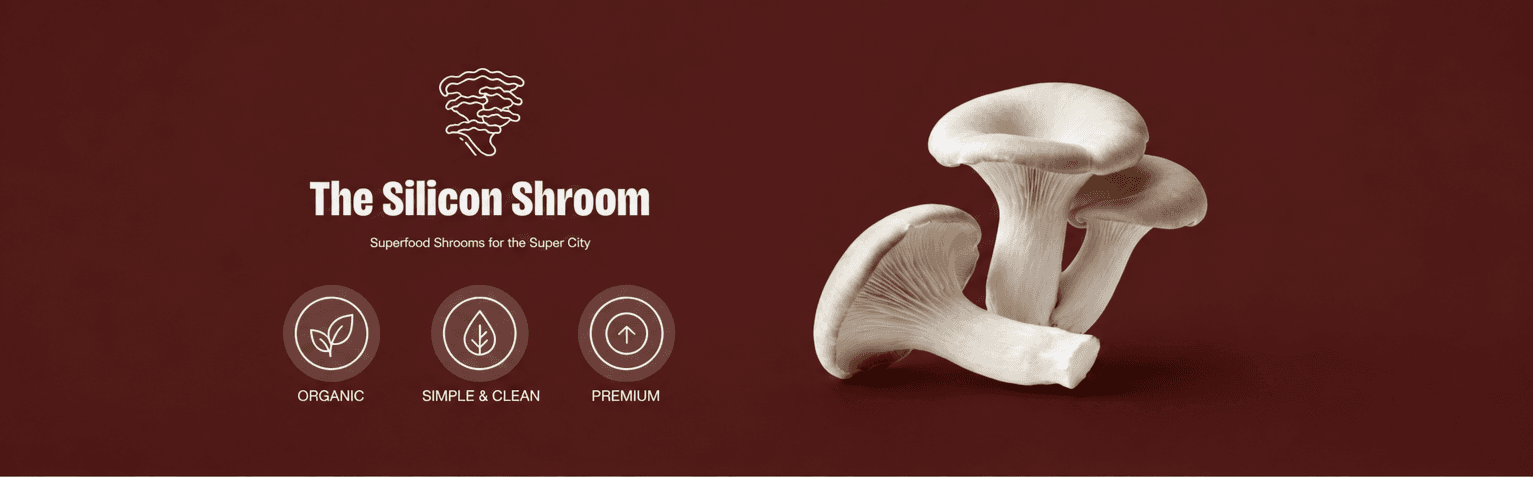
The Organic Difference
Most mushrooms
were grown
with chemicals.
Here is the truth about what goes into commercially grown mushrooms — and exactly how we do it differently.
90%
of commercial mushrooms
use synthetic fertilisers or growth promoters
60+
pesticide types
are approved for use on food crops in India
0
chemicals used by us
ever — at any stage of our growing process
24h
farm to your table
no cold chain, no preservatives, no additives
The Problem
Commercial mushroom
farming relies heavily
on synthetic chemistry.
Button mushrooms, shiitake, and even most oyster mushrooms sold in Indian supermarkets are grown in substrate treated with synthetic nitrogen fertilisers and growth promoters to increase yield.
Fungal diseases are a major threat in mushroom farms. The conventional solution is applying fungicides — often carbendazim and thiabendazole — directly on growing bags and even on harvested mushrooms as a post-harvest wash to extend shelf life.
These residues do not disappear when you wash or cook the mushroom. They absorb into the tissue. You eat what the mushroom absorbed.
Carbendazim
A systemic fungicide used on mushroom crops — classified as a potential endocrine disruptor and suspected carcinogen by European food agencies.
Synthetic Fertilisers
Added to growing substrate to boost yields. Creates denser mushrooms that look impressive but carry the residue into your food.
Post-Harvest Sprays
Applied after picking to slow browning. Common agents include sulphur dioxide and chlorine solutions — invisible on the shelf but present on the mushroom.
Wax Coatings
Some commercially grown mushrooms are wax-coated after harvest to maintain appearance during long supply chains. These are food-grade waxes, but wax is not food.
How We Grow
Zero chemicals.
At every step.
We do not skip chemicals as a marketing claim. We skip them because our process does not need them. When you control the environment properly, chemistry becomes unnecessary.
Clean Paddy Straw Substrate
We source untreated paddy straw from local farms — it has never seen a pesticide. This is the only growing medium our mushrooms ever touch. No synthetic soil, no added nutrients, no chemicals.
Sterilisation by Heat
The straw is sterilised using only heat and steam. No chemical sterilants. This kills competing organisms naturally and gives our spawn a clean environment to colonise.
Mycelium Colonisation
Oyster mushroom spawn is introduced into the sterilised straw. Over 3 weeks, white mycelium threads weave through every fibre — fed entirely by the straw. No fertiliser is added at any point.
Controlled Environment — No Fungicides
We manage temperature and humidity precisely so fungal contamination cannot take hold. This is why conventional farms need fungicides — they do not control the environment. We do.
Harvest at Dawn, Pack by Morning
Mushrooms are harvested by hand at first light and packed within hours. No post-harvest chemical treatment, no wax coating, no shelf-life extending sprays. Just pure mushrooms.

Growing in our Bengaluru facility
No chemicals. No shortcuts. Just biology.
Side by Side
The Silicon Shroom vs
Conventional Mushrooms
Health Impact
Why chemical-free
actually matters for you.
Mushrooms are high absorbers
Unlike root vegetables, mushrooms absorb everything in their growing environment directly into their tissue. Pesticide residues in the substrate end up in the mushroom — there is no protective skin to peel.
Fungicide residues survive cooking
Studies show that carbendazim and similar fungicide residues are heat-stable. Boiling, frying, or stir-frying does not eliminate them. You consume what was in the mushroom when it grew.
Cumulative exposure matters
No single meal causes harm. But if you eat mushrooms regularly — weekly or daily — the cumulative exposure to low-level pesticide and fungicide residues becomes meaningful over time.
Organic retains more nutrition
Chemical-free mushrooms grown in clean substrate have been shown to have higher antioxidant content, higher beta-glucan levels, and better Vitamin D concentration than conventionally grown equivalents.
Your gut microbiome responds
Fungicide residues do not discriminate. They can affect beneficial fungi in your gut microbiome — the same organisms that play a role in immunity and digestion. Organic mushrooms carry no such risk.
Freshness means more nutrients
Our same-day harvest-to-delivery model means you receive mushrooms at peak nutritional content. Mushrooms stored for days in transit lose up to 40% of their antioxidant content.
Our Promise
No chemical has ever touched our mushrooms. Not one. Not ever.
We grow in Bengaluru. We harvest at dawn. We deliver the same day. We have no interest in shortcuts — because shortcuts are how chemicals enter your food.