
The Intelligence Behind the Farm
Software engineers
who actually
grow mushrooms.
We instrument every variable, log every batch, and iterate on the farm the way we would on a software system. The result is cleaner mushrooms, fewer losses, and a data moat no competitor can replicate.
90%+
CV accuracy target
contamination detected before visible to human eye
3–8%
our contamination target
vs 15–25% industry average loss per cycle
48h
earlier detection
catching contamination before it spreads to adjacent bags
200
bags per cycle
every one monitored by sensors and camera zones
The Unfair Advantage
We build the tools.
We feel the problems.
Same day. Same room.
Most agritech companies are either agricultural operations that bolt on technology, or technology companies that have never grown anything. We are technology people operating the farm.
When a humidity spike causes early pinning, we see it in the IoT dashboard before the physical bags show any change. When a contamination alert fires, we can trace it to the substrate lot within seconds. The gap between observation and action — which costs most farms days — costs us minutes.
Traditional farm
Visual inspection once per day. Contamination spotted at advanced stage. Manual paper logs. No P&L per batch.
Sensor-only agritech
Climate data collected but not connected to batch records. No CV. No farm-specific workflows. No real-time alerts.
The Silicon Shroom
CV alerts connected to batch records. IoT readings in the same timeline as contamination events. Per-batch P&L from day one.
Layer 1
Computer Vision
Contamination Detection
Catching Trichoderma and bacterial blotch 48 hours before it's visible to the human eye — before it can sporulate and destroy adjacent bags.
Continuous Camera Coverage
ESP32-CAM modules are mounted at fixed angles across every grow zone. Images are captured at regular intervals through the full colonisation and fruiting cycle — day and night.
Edge Inference on the Device
A Raspberry Pi edge device runs the inference model locally — no cloud dependency, no latency. Each frame is scored for signs of Trichoderma (green mould), bacterial blotch, and substrate degradation.
Alert Before Spread
When a bag crosses the contamination confidence threshold, an alert fires immediately. The contaminated bag is isolated before the mould can sporulate and spread to adjacent bags.
Continuous Model Improvement
Every flagged image — confirmed or false positive — is added to the training dataset. Each grow cycle the model gets more accurate. Data from our own farm, on Indian mushroom contamination, is the moat.
Batch-Level Correlation
Every CV alert is linked to its batch record in the Farm OS — spawn source, substrate lot, inoculation date, environmental readings at time of detection. Root cause analysis in one view.
Hardware
ESP32-CAM
Image capture
WiFi-native, <₹400/unit, mounts at fixed angles per grow zone
Raspberry Pi
Edge inference
Runs the CV model locally — no cloud dependency, real-time scoring
USB Camera
High-res zones
Higher resolution capture for critical contamination-prone areas
Layer 2
IoT Environmental
Sensor Network
Oyster mushrooms are precise in their requirements. A 3°C temperature deviation or a drop below 85% humidity is the difference between a clean flush and a contaminated batch. We measure everything.
Temperature
DHT22 / SHT31 per zone
Target Range
24–28°C
Humidity
DHT22 / SHT31 per zone
Target Range
85–95% RH
CO₂ Levels
MH-Z19 NDIR sensor
Target Range
<1,200 ppm fruiting
Light Cycle
Digital light sensor
Target Range
12h / 12h cycle
ESP32-based mesh network.
Under ₹3,000 per grow-room bay.
Each ESP32 node reads temperature, humidity, and CO₂ and pushes readings over WiFi to the Farm OS every few minutes. No proprietary hardware, no vendor lock-in. Every component is replaceable from any Indian electronics supplier.
Layer 3
The Farm OS
A farm management system built specifically for how a mushroom farm actually runs — not adapted from a generic ERP. From spawn inoculation to per-batch profit, everything in one place.
Batch Tracking
Every bag is logged from spawn inoculation through harvest — substrate lot, spawn source, dates, weights, yield.
Pin Formation & Harvest Timing
Track the moment primordia (pins) appear and predict optimal harvest windows based on historical batch data from the same substrate source.
Per-Batch P&L
Real substrate cost vs actual yield per batch — not averaged across the grow room. Know exactly which substrate lot is most profitable.
CV Alert Feed
All contamination alerts surface directly in the batch record. No switching between systems — the full history of a bag is in one place.
Live Environmental Dashboard
IoT sensor readings stream into the batch timeline. If a temperature spike preceded contamination, you see it immediately.
Image Archive
Every camera frame tied to its batch. From a single row in the P&L, trace back to the exact images from that period.
What a spreadsheet can't do
Three things that change the moment you connect IoT to batch records.
Sensor readings are automatically written to the batch record — no manual data entry, no human error.
A contamination alert instantly links to the batch it came from, showing the environmental readings at that exact moment.
Per-batch P&L accounts for actual substrate cost and actual yield — not averages across the grow room.
The Full Picture
Three layers.
One farm. Every batch.
Layer 1
Computer Vision
ESP32-CAM modules watch every grow zone. Contamination detected 48h before human inspection would catch it.
Alerts → Batch record
Layer 2
IoT Sensors
ESP32 mesh monitors temperature, humidity, CO₂ across every bay, every few minutes, 24/7.
Readings → Batch timeline
Layer 3
Farm OS
The intelligence layer — correlates CV alerts with sensor spikes with batch records to surface root causes.
Data → Decisions
The data generated on our own farm — real Indian mushroom contamination images, real batch-level P&L, real environmental correlations — is the asset no competitor can fast-follow. It only exists because we are actually growing.
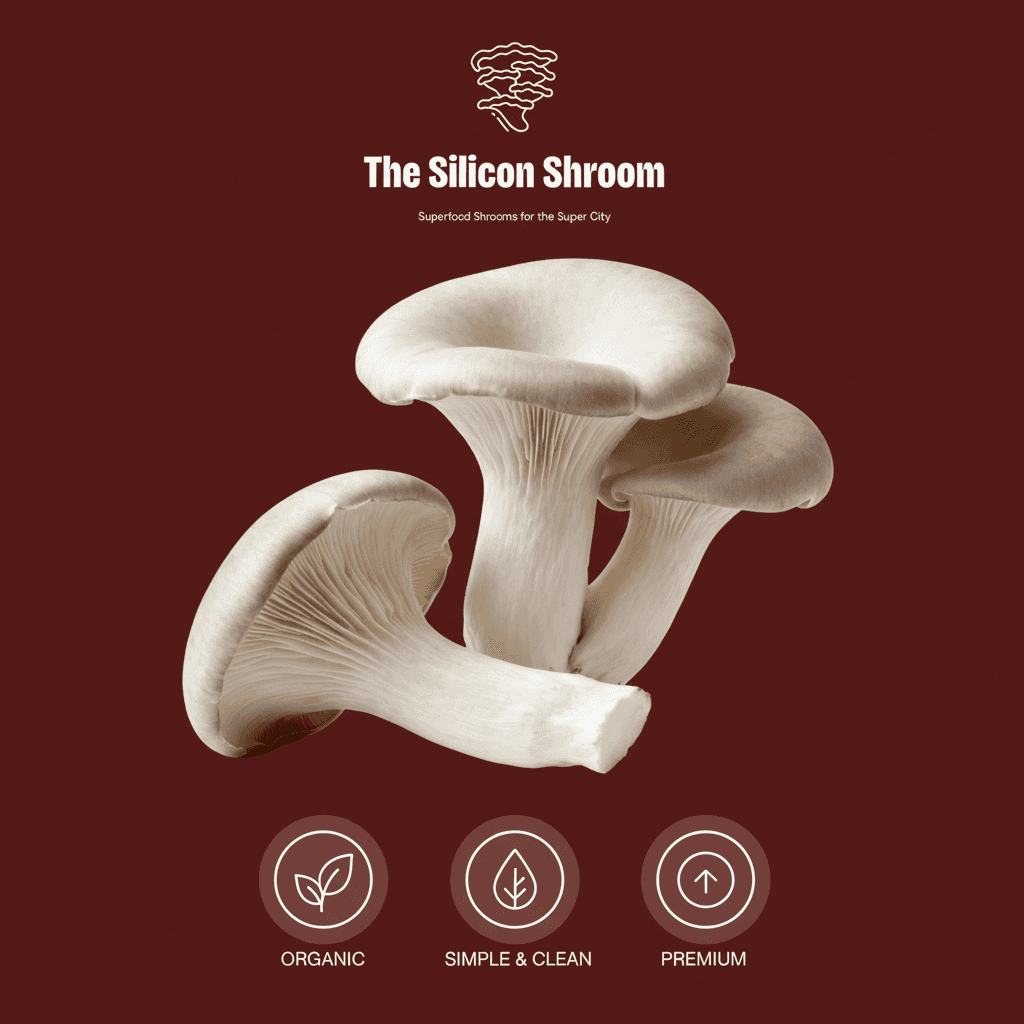
The proof is in the mushroom.
The Result
Cleaner mushrooms.
Every single batch.
The technology exists to make the mushrooms better. Order from The Silicon Shroom and taste the difference that data-driven farming makes.